HoReCa marketing: from search to booking, order and repeat visit
First, we identify where a restaurant, café, hotel or other hospitality business loses the guest: in search, the offer, on the website, during booking, ordering or confirmation. We then choose one focused task or ongoing development of the whole system.
Companies and partners we have worked with










From the first search to repeat choice, the system must work as one journey
A guest finds a venue or hotel, compares the offer, checks the location, reviews, menu, rooms, terms and availability. They then expect a straightforward path to booking, ordering or contacting and a clear confirmation.
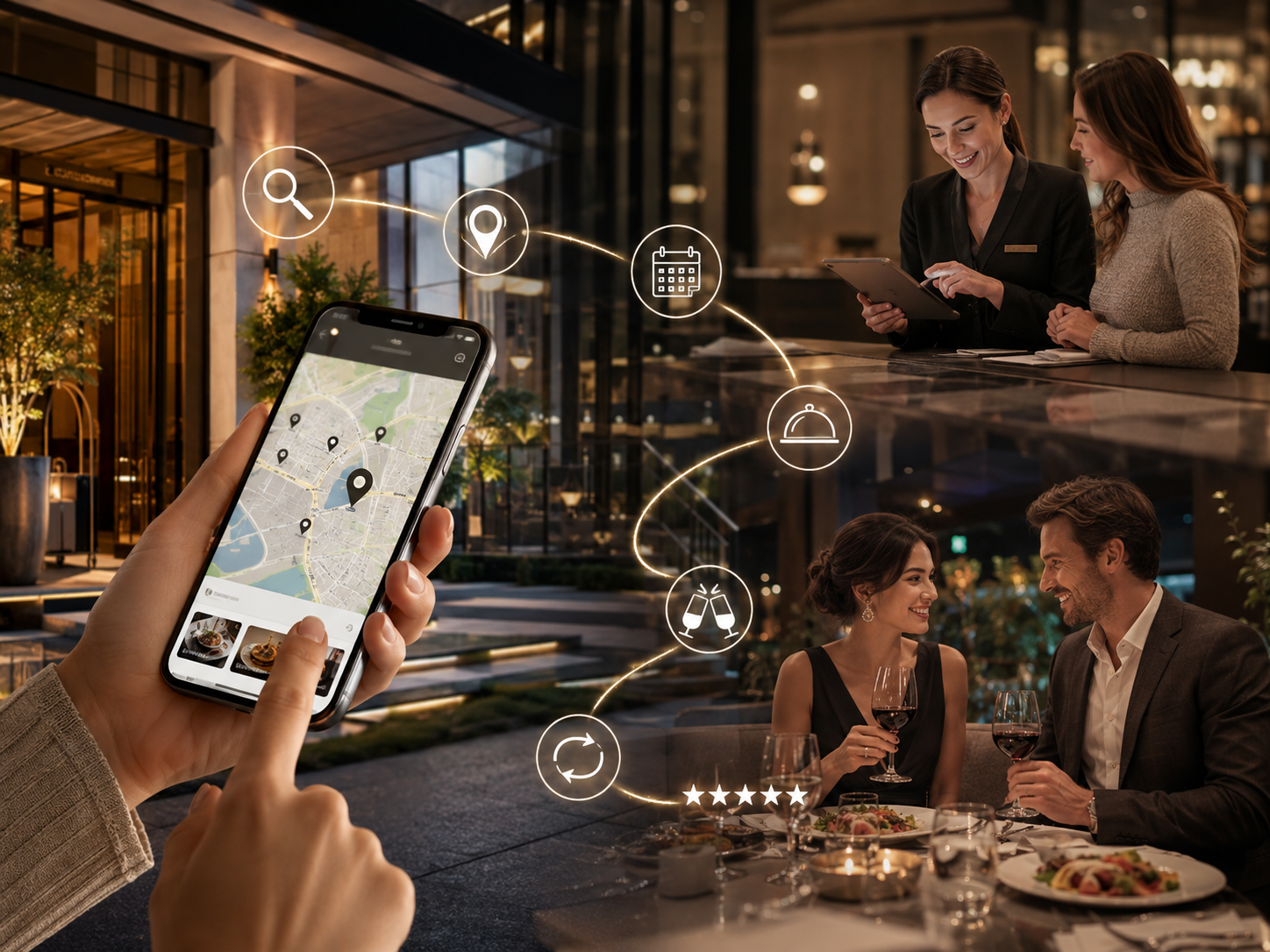
- Need
- Search and choice
- Offer and trust
- Booking, order or enquiry
- Confirmation and fulfilment
- Repeat choice
More traffic will not compensate for an outdated offer and a difficult ordering path
Menu, prices, hours, rooms, availability, terms and contact details must match across the website, Google, advertising, aggregators and real operations.
Review loss pointsVisibility does not increase bookings if the business cannot accept the guest
If the offer is outdated, the booking receives no confirmation, the menu does not match reality and the team responds late, additional advertising raises the cost of lost demand rather than the venue's occupancy.

Demand and reason for choice
We examine what the guest is looking for: a nearby venue, a specific cuisine, a room, an event space, delivery or an offer for a particular occasion.

Location and Google Business Profile
We compare address, hours, categories, phone, photos, menu, services and links against the venue's actual operations.

Website and offer
We assess whether the visitor understands what can be ordered or booked, how much it costs, what terms apply and how to take the next step.

Trust and evidence
We review real photos, reviews, the team, interior, rooms, menu, terms, service details and other verified reasons for choice.

Booking, order and confirmation
We test phone, forms, widgets, aggregators, online ordering, confirmations, cancellations and team response speed.

Fulfilment and repeat choice
We connect demand source, booking or order, confirmation, visit, no-show, fulfilment, review and repeat contact.
We start with the constraint that most prevents interest from becoming a booking, order or visit, not with an advertising channel.
One marketing approach does not fit the whole HoReCa sector
Priorities depend on how guests choose, seasonality, geography, capacity, the operational model and how the guest books or orders.

Restaurants, bistros and cafés
Cuisine, menu, atmosphere, location, reviews, current hours and a straightforward path to booking or visiting matter.

Bakeries and confectioneries
The decision is often local and fast, so the product range, hours, photos, seasonal offers and a map are important.

Hotels and accommodation
Guests need clear room types, terms, availability, facilities, photos and a reliable booking path.

Delivery and online ordering
Menu, prices, delivery zone, minimum order, fulfilment time and availability must match across all platforms.

Catering and events
Event format, guest count, menu, timelines, service area, evidence and a qualified enquiry matter.
Seasonal and tourism projects
Timely updates to hours and offers, multilingual content and demand preparation before the season begins are essential.

Chains and multiple locations
These require shared data rules, local pages, update owners and an honest presentation of each location's specifics.
One focused service or ongoing HoReCa development
Not every venue needs a new website, SEO and advertising at the same time. We first identify the minimum scope that can remove the main constraint.
Path A

Focused service
Suitable when the cause of lost guests is known and can be addressed within one agreed scope.
Restaurant website, event landing page, Local SEO, Google Ads, Meta Ads, online menu or booking-path improvement.
View servicesPath B
Ongoing development
From 3,000 zł net + VAT per month
Minimum 3 months
Suitable when the website, Local SEO, SEO, Google Business Profile, advertising, content and booking or order handling depend on each other and need one roadmap.
Growth Insider is responsible for strategy, priorities, planning, content, coordination and delivery of the agreed scope. The business provides verified data, access and budgets and approves key decisions.

Transparent terms, clear roles and a focus on measurable outcomes.
We manage HoReCa marketing as a system, not a collection of suppliers
Each cycle starts with the business's main constraint. We do not launch every tool at once or expand the scope without a clear commercial reason.

Strategy and priorities
We define the main constraint, dependencies, data owners, budget and criteria for the next decision.
Website and guest journey
We build a website or improve the path from offer to booking, order, call or enquiry.
Local SEO and Google Business Profile
We align locations, categories, hours, contacts, photos, menu, services and website pages.


Google Ads
We test existing demand after pages, data, conversions and the booking or order confirmation process are ready.

Meta Ads
We use visual offers, events, seasonality and retargeting when the proposition and materials are clear.

Content
We prepare menu pages, rooms, offers, events, FAQs, evidence and advertising messages from verified data.
SEO
We develop offer pages, locations and expert content as a cumulative source of relevant demand.
Analytics and decisions
We compare not just clicks but bookings, confirmations, visits, orders, no-shows, repeat choice and acquisition economics.
The first month builds the foundation; the following months launch and improve the system
Ongoing development is planned for a minimum of three months. The first month is the most intensive: promoting an unprepared offer increases losses and acquisition cost.

Month 1 — professional foundation
- We review the restaurant, hotel, delivery or booking model.
- We check menus, rooms, offers, locations, website, Google Business Profile, ads, seasonality and content.
- We build the path from search to visit, booking or order and agree the roadmap.
Why this matters: Without a strong foundation, later work increases the risk of losing budget, time and demand.


Month 2 — priority delivery
We address the main constraint, update pages and content, align data and launch only the channels the business is operationally ready for.
Focus: launch and systematisation
Month 3 — optimisation
We compare booking and order quality, confirmations, response speed, visits, no-shows, acquisition cost and repeat contacts. We agree the next cycle.
Focus: efficiency and the next cycle
What we record before launch and compare afterwards
Impressions, rankings and clicks are intermediate signals. Commercial decisions are based on booking and order quality, fulfilment, repeat choice and business economics.
Booking and order quality
Source, offer, date, guest count, value, contact validity and the share of confirmed actions.

Confirmation and fulfilment
Response speed, confirmation, cancellations, no-shows, visits, completed deliveries and gaps between promise and reality.

Economics and repeat choice
Cost per confirmed action, average check, margin, occupancy, repeat visit and customer lifetime value.
What a hospitality business may need separately
Ongoing support is not always necessary. Sometimes one project can remove the constraint.

Website development
When the website does not explain the offer, location, menu, rooms, terms, trust or the next step.
Website development for HoReCaLanding page
When an event, seasonal offer, banquet or separate service needs a focused enquiry path.
Landing page developmentLocal SEO
When the venue is poorly represented in local search, maps and Google Business Profile.
Local SEO for a restaurant or hotelSEO
When offers, services and expert content lack sustained organic visibility.
SEO for hospitality businesses
Google Ads
When guests are already actively searching for a restaurant, hotel, catering, delivery or event venue.
Google Ads for HoReCaMeta Ads
When demand is shaped through a visual offer, atmosphere, event, season or repeat contact.
Meta Ads for HoReCaLet's identify where the HoReCa business loses a booking, order or repeat guest
Describe your business model, locations, offer, website and current constraint. We will tell you whether one service is enough or an ongoing growth plan is needed.
Questions about HoReCa marketing
Restaurants, cafés, bakeries, confectioneries, hotels, accommodation providers, catering companies, delivery services, seasonal projects and multi-location chains. The approach depends on the demand model and how guests book or order.
The agreed roadmap may include website development or improvement, Local SEO, SEO, Google Business Profile, Google Ads, Meta Ads, content and analytics. Not every area is launched at once.
Yes, when the website is the main constraint. Small changes may fit within the current cycle. A large website, online store, booking system or integration is scoped as a separate project.
The first month covers diagnosis and professional foundations, the second focuses on priority delivery and the third gathers initial data and optimises decisions.
Some changes may appear earlier, but we generally plan to assess sustained movement after 5–6 months or longer. Timing depends on competition, site condition, geography, seasonality and implementation speed.
The price covers an agreed monthly scope of strategy, coordination, content and delivery. Advertising budgets, paid platforms, hosting, licences, PMS, POS, CRM, integrations and major web development are charged separately.